Solo agents run out of room.
Plan, execute, review, and ship in one voice eats the context window before anything lands. More compute doesn't fix what's structural.
00 — o8
One primary orchestrator routes scoped work to specialized sub-agents. A governance layer reviews every output before it touches your main branch. Local-first. Any model.
Your code never touches our servers. Everything runs on your machine.
Your API keys. Your quota. Your rates. o8 doesn't mediate or meter.
No signup. No telemetry. Download the binary and run it.
This repo is the changelog. The engineering source stays private.
Stretch a paid plan across plan, build, and ship without running dry.
Watch parallel sub-agents work. Steer mid-flight. Approve what merges.
No session reset. Pick up tomorrow where today's dispatch left off.
Shared governance and memory. Separate accounts for each operator.
A single agent stretched across plan, execute, review, and ship runs out of room before it ships anything. The usual workaround is more compute. The actual fix is more structure — delegating scoped work to sub-agents so the orchestrator stays lean enough to reason.
Plan, execute, review, and ship in one voice eats the context window before anything lands. More compute doesn't fix what's structural.
A single agent marking its own work has no second opinion. It approves what it wrote and moves on.
Agents narrate dispatches they never fire. The operator reads the text, believes it, walks away.
Without a gate, the first thing to pass the model's self-check hits main. Regressions ride along.
Holding full context in every turn chews through paid-plan quota faster than it ships. Delegation keeps the orchestrator turn lean; sub-agents run on their own quotas.
The orchestrator decides what needs to happen. Sub-agents execute in isolation with only the context their task requires. Governance sits between the sub-agent output and the base branch.
The top layer decides what needs to happen and who does it. It reads diffs. It never writes production code itself.
Each sub-agent runs on its own branch with only the files and prompt its task requires. No shared state during execution.
Every sub-agent output passes through typecheck, static checks, and orchestrator review before anything merges.
Review findings and dispatch patterns feed back into future prompts. The system gets harder to fool over time.
Approvals, reviews, and merges all land in a durable ledger. You can retrace any shipped change to the conversation that produced it.
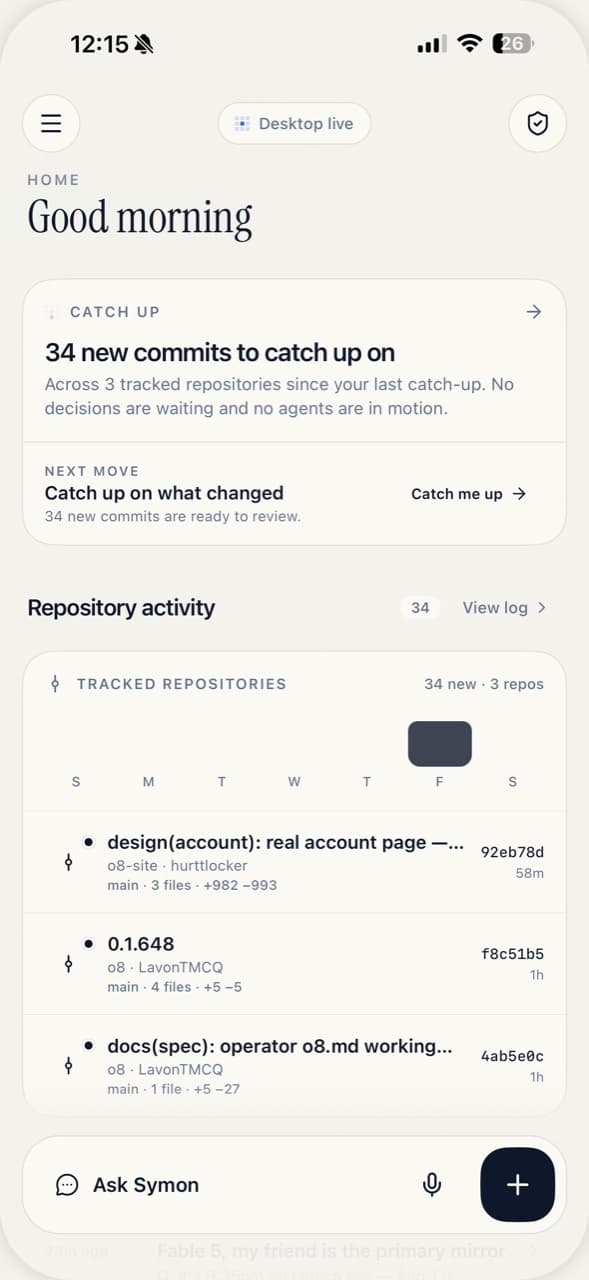
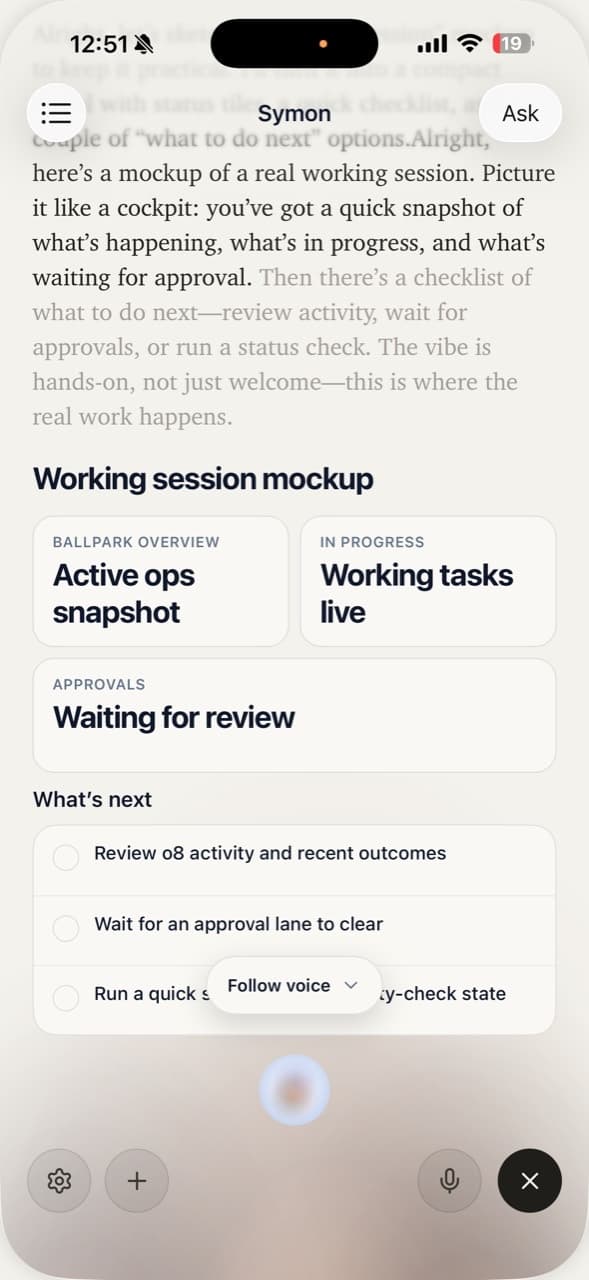
Headless daemons route and gate. What's missing is a window for the operator to see what's happening, steer mid-flight, and approve what ships. o8 is that window.
Not every orchestration tool makes the same tradeoffs. Here is how o8 lines up against the axes that actually matter.
Work is split into packets small enough to finish cleanly in one turn. Context stays lean because nothing tries to hold everything.
The orchestrator reads the diff, runs the gates, and writes a verdict. Nothing ships without a signed record.
Lane reconcile catches orphaned work. A supervisor watches for stuck sessions. Bash-merge paths and verb paths both reconcile back to clean state.
The governance layer enforces quality mechanically. The model tier becomes a cost and speed knob, not a correctness knob.
Parallel sub-agents work in isolation. The orchestrator stitches outputs together. A single human reads the summary, not the stream.
Every sub-agent output passes through a gate before merge. Typecheck, static checks, diff inspection, audit. The orchestrator signs off or returns it for a fix.
No sub-agent output reaches main until tsc says yes. Type regressions are caught before the review turn even starts.
Structural rules run on every diff. Violations fail the lane, block the merge, and return the turn to the sub-agent with a fix-it steer.
Not summaries. Not status signals. The full diff, file by file. Every verdict is grounded in the code, not the narration.
Each merge carries a decision record: reviewer, timestamp, findings, and the commit range it covers. Nothing is implicit; nothing goes untraced.
Oversized modules trigger follow-up work the moment a merge lands. Main stays clean as the system grows, without anyone having to ask.
o8 dispatches against o8. Every pass ships features, catches its own friction, files the bugs, and merges the fixes.
Ten scoped packets dispatched, reviewed, and merged in a single operator session. Plain-English dispatches, no tool IDs typed.
Every rough edge from the same session became an issue before it recurred. The loop generates its own regression backlog.
Human-through-product dogfood score climbed fifteen points after the same session's hand-fixes landed. The loop sharpens itself on every pass.
Bugs filed, packets written, sub-agents ship patches. The orchestrator reviews the fix the same way it reviewed the feature. Same pipeline, both directions.
Stuck lanes recover. Orphaned worktrees get healed. Even the paths that bypass the primary handler land in a valid state by the next tick.